
Note
Go to the end to download the full example code.
Transmit diversity: Alamouti and space-time block codes#
Diversity is the slope of the error rate at high SNR: with \(L\) independent fading branches, \(P_b \propto \bar\gamma^{-L}\). Receive diversity is obtained by maximal-ratio combining (MRC); Alamouti’s code obtains the same order at the transmitter, without channel knowledge there, at the price of splitting the power over the two antennas (3 dB). BPSK, i.i.d. Rayleigh fading constant over a code block; the lines are the closed form of MRC with \(L\) branches of mean SNR \(\gamma\) (Proakis & Salehi, eq. 13.4-15):
\[P_b = \left(\frac{1 - \mu}{2}\right)^{L} \sum_{k=0}^{L-1}
\binom{L - 1 + k}{k} \left(\frac{1 + \mu}{2}\right)^{k},
\qquad \mu = \sqrt{\frac{\gamma}{1 + \gamma}}.\]
import matplotlib.pyplot as plt
import numpy as np

import comnum
from comnum.plot import BACKGROUND, MUTED

code = comnum.Ostbc.alamouti()
points = np.arange(0.0, 31.0, 3.0)


def simulate(n_tx, n_rx, eb_db, seed):
    """BER of BPSK: Alamouti for two transmit antennas, MRC otherwise."""
    g = comnum.db2lin(eb_db)
    errors = total = t = 0
    blocks = 20_000
    while errors < 200 and total < 4e6:
        rng = comnum.Rng.stream(seed, "diversity", int(eb_db), t)
        bits = comnum.bits(2 * blocks, rng)
        s = 1.0 - 2.0 * bits
        h = comnum.mimo_channels(blocks, n_rx, n_tx, rng)
        if n_tx == 2:
            x = code.encode(s)  # 2 antennas x 2 uses per block
            y = np.einsum("nij,njt->nit", h, x.reshape(2, blocks, 2).transpose(1, 0, 2))
            y = y + rng.complex_noise(y.size, 1 / g).reshape(y.shape)
            est, _ = code.decode(h, y.transpose(1, 0, 2).reshape(n_rx, 2 * blocks), 1 / g)
        else:  # one antenna: two symbols per block over the same channel, MRC
            x = s.reshape(blocks, 2)
            y = h[:, :, :1] * x[:, None, :] + rng.complex_noise(blocks * n_rx * 2, 1 / g).reshape(
                blocks, n_rx, 2
            )
            est = (np.conj(h[:, :, :1]) * y).sum(axis=1).reshape(-1)
        errors += int(((est.real < 0) != (bits == 1)).sum())
        total += bits.size
        t += 1
    return errors / total


configs = {
    "1 × 1": (1, 1, 1, 1.0),
    "1 × 2, MRC": (1, 2, 2, 1.0),
    "2 × 1, Alamouti": (2, 1, 2, 0.5),
    "2 × 2, Alamouti": (2, 2, 4, 0.5),
}
fig, ax = plt.subplots()
eb = np.linspace(0, 30, 301)
for (name, (nt, nr, branches, share)), marker in zip(
    configs.items(), ["o", "s", "D", "^"], strict=True
):
    (line,) = ax.semilogy(
        eb,
        comnum.theory_ber_rayleigh_mrc(eb + comnum.lin2db(share), branches=branches),
        linewidth=1.4,
    )
    sim = np.array([simulate(nt, nr, e, seed=nt * 10 + nr) for e in points])
    keep = sim > 0
    ax.semilogy(
        points[keep],
        sim[keep],
        marker,
        color=line.get_color(),
        markeredgecolor=BACKGROUND,
        label=name,
    )
ax.plot([], [], color=MUTED, linewidth=1.4, label="theory")
ax.set(
    ylim=(1e-6, 0.5),
    xlim=(0, 30),
    xlabel="$E_b/N_0$ (dB)",
    ylabel="bit error rate",
    title="BPSK over Rayleigh fading: diversity",
)
ax.legend()
fig.tight_layout()
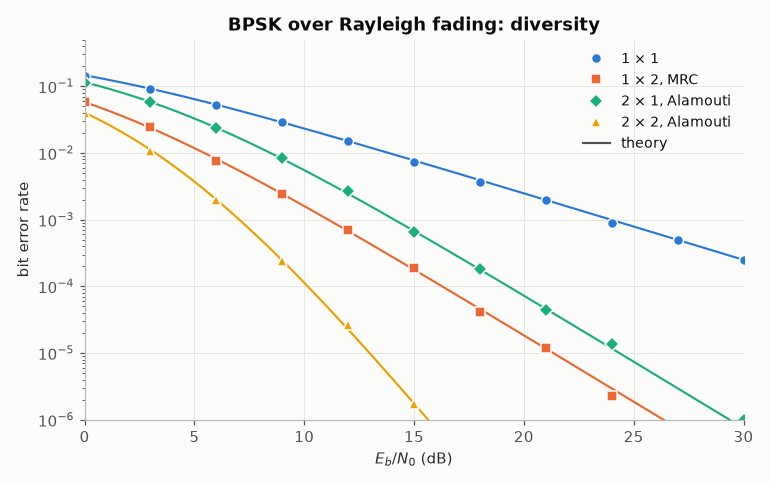
The rate-3/4 codes extend transmit diversity to three and four antennas.
for code34 in [comnum.Ostbc.rate_3_4(3), comnum.Ostbc.rate_3_4(4)]:
    print(code34, f"{code34.n_symbols} symbols over {code34.n_slots} channel uses")
Ostbc("rate 3/4, 3 antennas", n_tx=3, rate=0.75) 3 symbols over 4 channel uses
Ostbc("rate 3/4, 4 antennas", n_tx=4, rate=0.75) 3 symbols over 4 channel uses
Total running time of the script: (0 minutes 24.950 seconds)