
Note
Go to the end to download the full example code.
Constellations and Gray labels#
The constellations of comnum carry the Gray labels of OptiCommPy: point i of
c.points carries the bits of i, most significant bit first, and two nearest
neighbours differ by a single bit. A symbol error to a neighbour therefore costs one
bit error, which is what makes the approximation \(P_b \approx P_s / \log_2 M\)
of the bit error rate accurate at high SNR.
import matplotlib.pyplot as plt
import numpy as np

import comnum
from comnum.plot import BACKGROUND, BLUE, MUTED

fig, axes = plt.subplots(1, 3, figsize=(9.5, 3.6))
for ax, (kind, m) in zip(axes, [("qam", 16), ("psk", 8), ("pam", 4)], strict=True):
    c = comnum.Constellation(kind, m).normalized()
    p = c.points
    k = c.bits_per_symbol
    ax.scatter(p.real, p.imag, s=46, color=BLUE, zorder=3, edgecolor=BACKGROUND, linewidth=1.5)
    for i, z in enumerate(p):
        ax.annotate(
            format(i, f"0{k}b"),
            (z.real, z.imag),
            textcoords="offset points",
            xytext=(0, 7),
            ha="center",
            fontsize=8,
            color=MUTED,
        )
    lim = 1.35 * np.abs(p).max()
    ax.set(xlim=(-lim, lim), ylim=(-lim, lim), aspect="equal", title=f"{m}-{kind.upper()}")
    ax.set_xlabel("in phase")
axes[0].set_ylabel("quadrature")
fig.tight_layout()
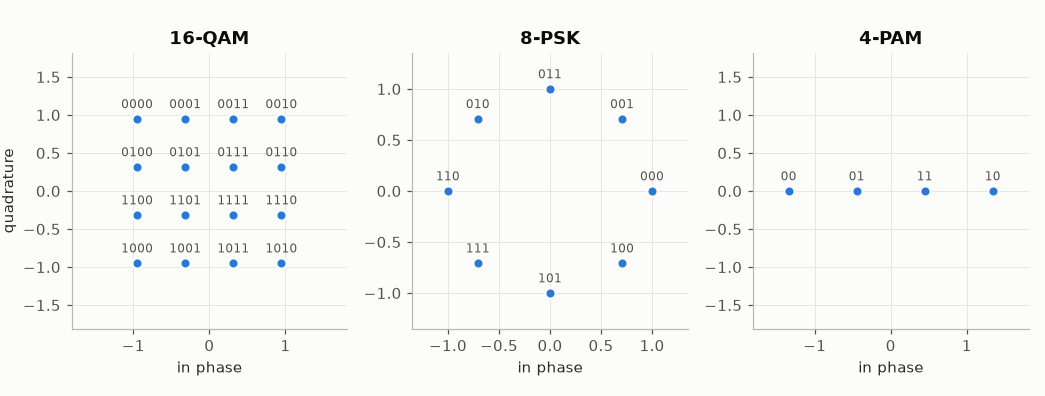
Neighbours differ by one bit: check it on 64-QAM.
nearest-neighbour pairs: 112
bits that differ: {1}
Total running time of the script: (0 minutes 0.163 seconds)