
Note
Go to the end to download the full example code.
Proakis & Salehi 2008, Sec. 3.3-2: MSK has the error rate of BPSK#
Minimum-shift keying is continuous-phase FSK with a modulation index of 1/2. Section 3.3-2 of J. G. Proakis and M. Salehi, Digital Communications, 5th ed., 2008, shows that its signal is an offset QPSK whose quadrature pulses are half sinusoids, so that coherent detection over AWGN decides the bits with the BER of BPSK, \(Q(\sqrt{2 E_b/N_0})\), once the bits are precoded so that each decides a sign of the equivalent offset QPSK signal.
Without precoding, the information bits are the phase increments, and a symbol-by-
symbol decision on the phase states of the maximum-likelihood path decides each bit
from two consecutive phases: an error in one phase affects two bits, and the BER is
that of differentially decoded BPSK, \(2p(1 - p)\) with \(p\) the BER of
BPSK. The blocks cpm_tx and cpm_rx run the maximum-likelihood sequence
detector on the phase trellis in both cases; specs/validation/msk_bpsk.yaml
checks the precoded case in CI within 4 % at 2, 4 and 6 dB.
import matplotlib.pyplot as plt
import numpy as np

import comnum
from comnum.plot import BACKGROUND, MUTED

EBN0 = np.arange(0.0, 9.0, 1.0)
results = comnum.run_spec(
    {
        "name": "msk_bpsk",
        "seed": 3,
        "cases": [{"precode": True}, {"precode": False}],
        "grid": {"ebn0_db": list(EBN0)},
        "link": [
            {"type": "source", "constellation": "BPSK", "n_symbols": 4000},
            {
                "type": "cpm_tx",
                "h": "1/2",
                "pulse": "rec",
                "length": 1,
                "sps": 4,
                "precode": "$precode",
            },
            {"type": "awgn_ebn0", "ebn0_db": "$ebn0_db"},
            {
                "type": "cpm_rx",
                "h": "1/2",
                "pulse": "rec",
                "length": 1,
                "sps": 4,
                "detector": "ml",
                "precode": "$precode",
            },
        ],
        "metrics": {"report": ["ber"], "scale": "none"},
        "stop": {"min_errors": {"ber": 400}, "min_trials": 2, "max_trials": 2000},
    }
)


def bpsk(ebn0_db):
    return comnum.theory_ber(2, ebn0_db, "psk")


fig, ax = plt.subplots()
fine = np.linspace(0, 8, 81)
ax.semilogy(fine, bpsk(fine), color=MUTED, linewidth=1.4, label="BPSK, $Q(\\sqrt{2E_b/N_0})$")
ax.semilogy(fine, 2 * bpsk(fine) * (1 - bpsk(fine)), ":", color=MUTED, linewidth=1.4,
            label="differentially decoded BPSK, $2p(1-p)$")  # fmt: skip
for precode, marker, label in [(True, "o", "MSK, precoded"), (False, "s", "MSK, not precoded")]:
    _, ber, lo, hi = results.series("ebn0_db", "ber", interval=True, precode=precode)
    ax.errorbar(EBN0, ber, yerr=[ber - lo, hi - ber], fmt=marker, markeredgecolor=BACKGROUND,
                capsize=0, label=label)  # fmt: skip
ax.set(
    xlim=(0, 8),
    ylim=(1e-4, 0.5),
    xlabel="$E_b/N_0$ (dB)",
    ylabel="bit error rate",
    title="MSK with maximum-likelihood sequence detection over AWGN",
)
ax.legend(loc="lower left")
fig.tight_layout()
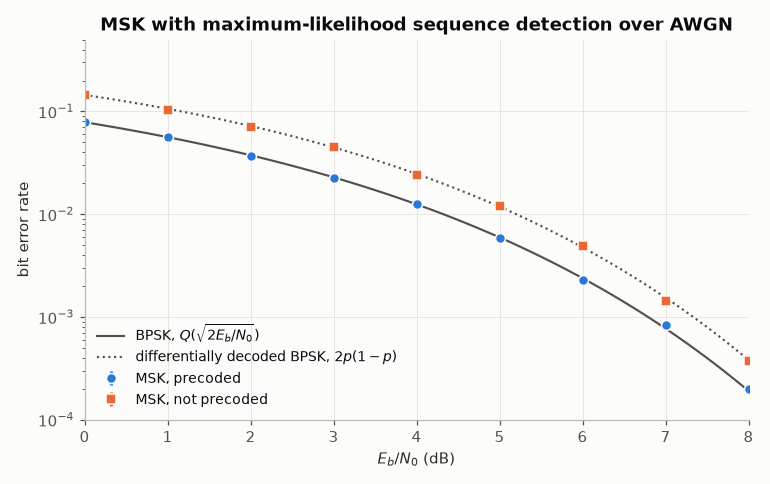
The precoded points lie on the BPSK curve within their intervals.
Eb/N0 = 0 dB: MSK 7.935e-02, BPSK 7.865e-02
Eb/N0 = 1 dB: MSK 5.653e-02, BPSK 5.628e-02
Eb/N0 = 2 dB: MSK 3.664e-02, BPSK 3.751e-02
Eb/N0 = 3 dB: MSK 2.270e-02, BPSK 2.288e-02
Eb/N0 = 4 dB: MSK 1.250e-02, BPSK 1.250e-02
Eb/N0 = 5 dB: MSK 5.898e-03, BPSK 5.954e-03
Eb/N0 = 6 dB: MSK 2.266e-03, BPSK 2.388e-03
Eb/N0 = 7 dB: MSK 8.418e-04, BPSK 7.727e-04
Eb/N0 = 8 dB: MSK 1.992e-04, BPSK 1.909e-04
Total running time of the script: (0 minutes 0.682 seconds)