Tutorials#
Seven guided scripts, each a complete program that runs as is (the figures of these pages are produced when the documentation is built). They go from the first call to a campaign run from the command line, then to the tools that look inside a chain:
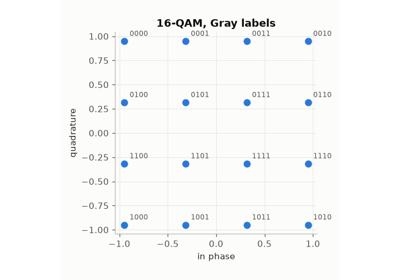
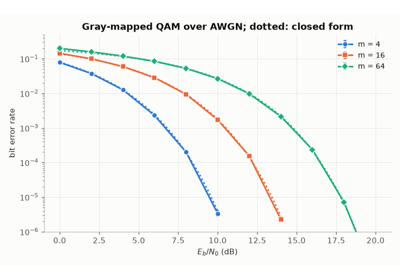
A first link — bits, constellation, noise, decisions, the closed form, and the same link as a chain on the parallel runner.
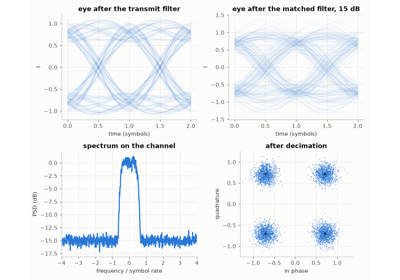
A classical single-carrier chain — pulse shaping, matched filter, decimation; the eye diagram and the spectrum; phase noise and carrier recovery as variants.
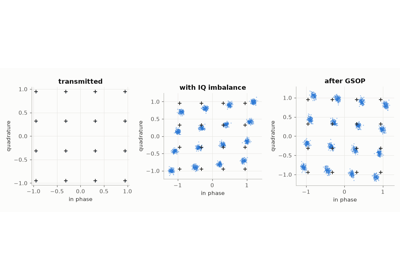
Writing a block in Python — a transmitter IQ imbalance and its blind compensation as Python blocks, checked against the native blocks trial for trial.
Specifications and the command line — the chain as a YAML file, expected results, the operating point of a metric, and the
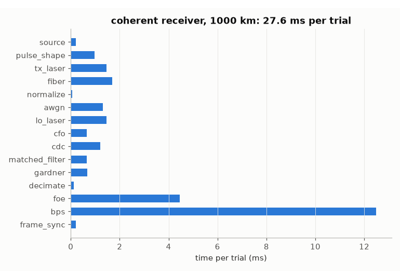
comnumcommand.Where the time goes — the profile of a chain, block by block, on both runners; two settings compared; the price of a Python block.
Looking at the signals — the trace of one trial, probes during a campaign,
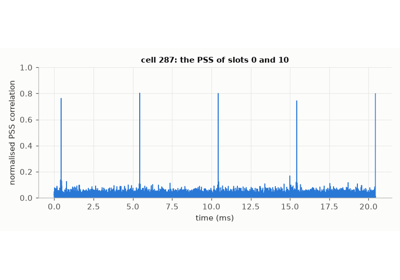
dumprecordings at a point of the link, and a Python block as a tap.A measured signal — a capture of a software radio through the front end, the LTE cell search and the MIB, the FM stereo multiplex and its RDS; the same code on a simulated capture and on a HackRF recording.
The user guide is the reference for what the tutorials touch; the gallery has the classical curves.