
Note
Go to the end to download the full example code.
A measured signal#
A capture of a software radio goes through the same blocks as a simulation. This tutorial takes two: the LTE downlink of a cell (its identity and the master information block of every frame), and an FM station with its stereo multiplex and its radio data system. Both are simulated here, so that the page builds anywhere; the same calls read the recordings of a HackRF One at the end of the page.
The front end is comnum.select_channel(): it removes the DC offset of the
converter, shifts the channel of interest to 0 Hz and resamples it by the exact
rational ratio of the two rates under a low-pass filter whose window rejects the
neighbouring channels by 80 dB.
import matplotlib.pyplot as plt
import numpy as np

import comnum
from comnum.plot import BACKGROUND
An LTE cell. Twenty frames of a 5 MHz cell of two antenna ports at 7.68 MS/s
(comnum.lte_frame() builds the PSS, the SSS, the cell-specific reference
signals and the PBCH of 3GPP TS 36.211), through a flat two-port channel, an
oscillator 13 kHz off and 5 dB of SNR: the kind of signal a HackRF records.
rng = comnum.Rng(287)
fs = 7.68e6
frames = [comnum.lte_frame(287, sfn=s, n_rb=25, ports=2, rng=rng) for s in range(668, 688)]
h = np.array([1.0, 0.6 * np.exp(0.7j)])
x = np.concatenate([h @ f for f in frames])
n = np.arange(len(x))
x = x * np.exp(2j * np.pi * 13.4e3 * n / fs)
gen = np.random.default_rng(1)
sigma = np.sqrt(np.mean(np.abs(x) ** 2) / 10**0.5)
x = x + sigma * (gen.standard_normal(len(x)) + 1j * gen.standard_normal(len(x))) / np.sqrt(2)
The six central resource blocks of an LTE carrier carry the synchronisation signals and the broadcast channel in every bandwidth, so the receiver reads them at 1.92 MS/s. The cell search tries the three PSS over a grid of frequency offsets, refines the offset on the cyclic prefixes, and reads the SSS to get the identity and the start of the frames; the MIB is then decoded in every frame, its timing tracked on the PSS.
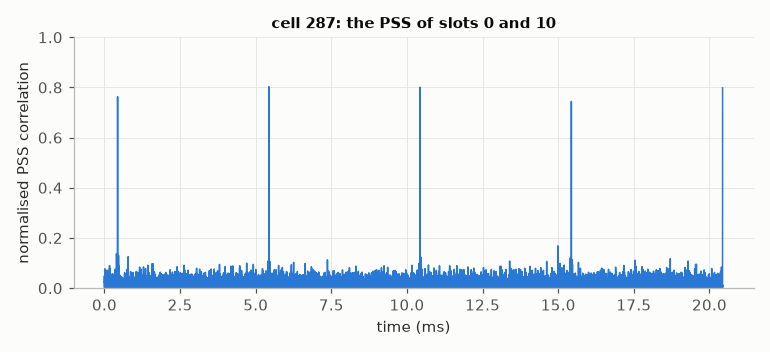
cell 287, offset +13408 Hz, PSS metric 0.80
MIB decoded in 20 frames; the first: {'start': 0, 'sfn': 668, 'ports': 2, 'n_rb': 25, 'phich_extended': False, 'phich_ng': 1.0, 'spare': [0, 0, 0, 0, 0, 0, 0, 0, 0, 0]}
The correlation of the capture with the PSS, after the offset is removed: one peak every 5 ms, the signature of the cell.
yy = y * np.exp(-2j * np.pi * cell["cfo_hz"] * np.arange(len(y)) / 1.92e6)
pss = comnum.lte_pss(cell["n_cell_id"] % 3)
replica = np.fft.ifft(np.concatenate([[0], pss[31:], np.zeros(65), pss[:31]]))
seg = yy[: int(0.0205 * 1.92e6)]
c = np.abs(np.correlate(seg, replica, "valid")) ** 2
e = np.convolve(np.abs(seg) ** 2, np.ones(128), "valid") * np.vdot(replica, replica).real
fig, ax = plt.subplots(figsize=(7, 3.2))
ax.plot(np.arange(len(c)) / 1.92e3, c / e, lw=1)
ax.set(xlabel="time (ms)", ylabel="normalised PSS correlation", ylim=(0, 1))
ax.set_title(f"cell {cell['n_cell_id']}: the PSS of slots 0 and 10", fontsize=10)
fig.tight_layout()
findfont: Failed to find font weight semibold for DejaVu Sans, now using 700.
An FM station. The stereophonic multiplex of ITU-R BS.450-4 (the pilot at 19 kHz, the difference channel around 38 kHz) with the RDS of NRSC-4 / EN 50067 on its 57 kHz subcarrier: the name of the station in groups of type 0A, a radiotext in groups 2A. The multiplex frequency-modulates a carrier with 75 kHz of maximum deviation, which a capture at 2.4 MS/s receives 300 kHz above its tuning frequency.
fs_mpx = 228e3
t = np.arange(int(1.2 * fs_mpx)) / fs_mpx
left, right = 0.6 * np.sin(2 * np.pi * 1e3 * t), 0.3 * np.sin(2 * np.pi * 2.5e3 * t)
ps, text = b"TUTORIAL", b"Hello, comnum!  "
groups = [comnum.rds_group_bits([0xF20C, s, 0, ps[2 * s] << 8 | ps[2 * s + 1]]) for s in range(4)]
for s in range(4):
    c4 = text[4 * s : 4 * s + 4]
    groups.append(
        comnum.rds_group_bits([0xF20C, (2 << 12) | s, c4[0] << 8 | c4[1], c4[2] << 8 | c4[3]])
    )
d = comnum.rds_differential_encode(np.concatenate(groups))
mpx = comnum.fm_multiplex(left, right, fs_mpx, rds_bits=d)
capture = comnum.resample_rational(comnum.fm_modulate(mpx, fs_mpx, 1.0), fs_mpx, 2.4e6, 110e3)
capture = capture * np.exp(2j * np.pi * 300e3 * np.arange(len(capture)) / 2.4e6)
The receiver: the front end to 228 kHz, the polar discriminator
(comnum.fm_discriminator() gives the multiplex in hertz of deviation), then
the stereo decoder and the RDS receiver on the same multiplex.
y = comnum.select_channel(capture, 2.4e6, 300e3, fs_mpx, 110e3)
m = comnum.fm_discriminator(y, fs_mpx)
audio = comnum.fm_stereo_decode(m, fs_mpx)
rds = comnum.rds_receive(m, fs_mpx)
print(f"stereo: {audio['stereo']}, pilot {audio['pilot_hz']:.0f} Hz of deviation")
print(
    f"PI {rds['pi']:#06x}, PS {rds['ps']!r}, radiotext {rds['radiotext']!r}, {rds['valid_blocks']} of {rds['blocks']} blocks"
)

fig, axes = plt.subplots(1, 2, figsize=(9, 3.2))
f = np.fft.rfftfreq(len(m), 1 / fs_mpx)
spectrum = np.abs(np.fft.rfft((m - m.mean()) * np.hanning(len(m)))) ** 2
axes[0].semilogy(f / 1e3, spectrum / spectrum.max(), lw=0.6)
axes[0].set(xlabel="frequency (kHz)", ylabel="multiplex spectrum", xlim=(0, 100), ylim=(1e-9, 2))
for pos, name in ((19, "pilot"), (38, "L − R"), (57, "RDS")):
    axes[0].annotate(name, (pos, 1.0), (pos, 1.2), ha="center", fontsize=8)
ta = np.arange(2400) / audio["fs"] * 1e3
axes[1].plot(ta, audio["left"][24000:26400], lw=0.8, label="left, 1 kHz")
axes[1].plot(ta, audio["right"][24000:26400], lw=0.8, label="right, 2.5 kHz")
axes[1].set(xlabel="time (ms)", ylabel="audio", xlim=(0, 4))
axes[1].legend(loc="upper right", fontsize=8, frameon=False, facecolor=BACKGROUND)
fig.tight_layout()
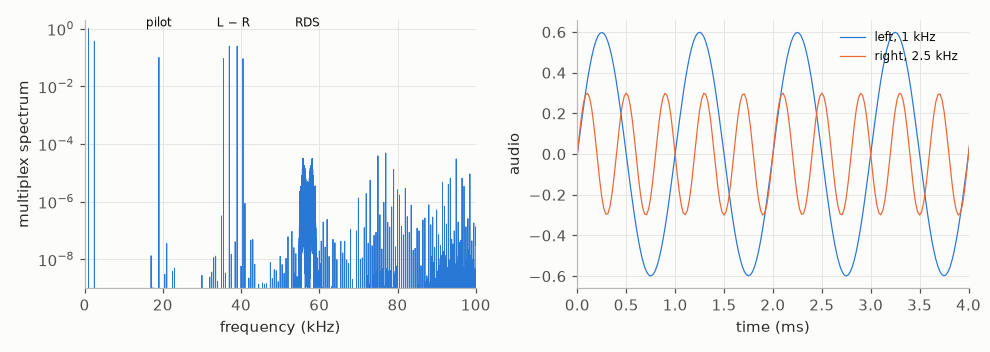
stereo: True, pilot 6746 Hz of deviation
PI 0xf20c, PS 'TUTORIAL', radiotext 'Hello, comnum!', 50 of 52 blocks
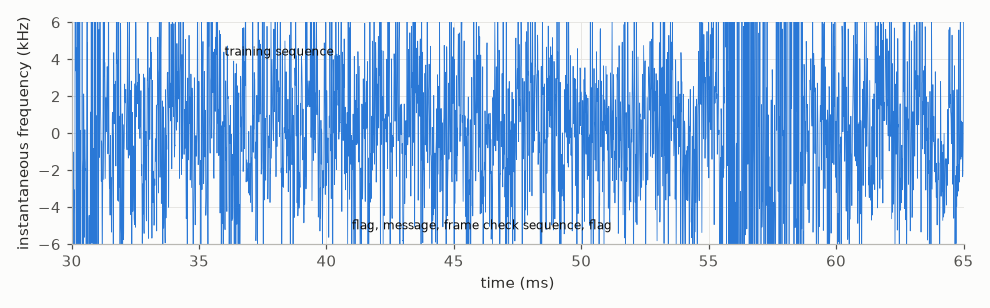
Ships: the AIS. The automatic identification system (ITU-R M.1371-5) sends
256-bit packets of GMSK at 9600 bit/s on two VHF channels, 161.975 and 162.025 MHz.
comnum.ais_transmit() builds the packets of three position reports (the
training sequence, the HDLC frame, NRZI), here captured at 2 MS/s 25 kHz below the
channel at 10 dB of SNR; the receiver is comnum.select_channel() to 153.6 kHz
(16 samples per bit) and comnum.ais_receive(): the polar discriminator, a bit
clock from the zero crossings, the frames whose check sequence is correct, and the
fields of the messages, with their !AIVDM sentence.
fs_ais = comnum.ais_front_end_rate()
reports = [
    comnum.ais_position_report(
        200000000 + k,
        lat_deg=46.1234,
        lon_deg=-9.8765,
        sog_knots=8.4,
        cog_deg=271.5,
        heading_deg=270,
        timestamp=42,
    )
    for k in range(3)
]
packets = comnum.resample_rational(comnum.ais_transmit(reports, fs_ais), fs_ais, 2e6, 7e3)
n = np.arange(len(packets))
capture = packets * np.exp(2j * np.pi * 25e3 * n / 2e6)
capture = capture + np.sqrt(2e6 / 25e3 / 10 / 2) * (
    gen.standard_normal(len(n)) + 1j * gen.standard_normal(len(n))
)
y = comnum.select_channel(capture, 2e6, 25e3, fs_ais, 12.5e3)
for p in comnum.ais_receive(y, fs_ais):
    m = p["message"]
    print(
        f"{p['start_bit'] / 9600:6.3f} s  {p['aivdm'][0]}  MMSI {m['mmsi']}, "
        f"{m['position']['lat_deg']:.4f} N {-m['position']['lon_deg']:.4f} W, {m['position']['sog_knots']} kn"
    )

fig, ax = plt.subplots(figsize=(9, 2.8))
f_inst = comnum.fm_discriminator(y, fs_ais)
t_ais = np.arange(len(f_inst)) / fs_ais * 1e3
ax.plot(t_ais, f_inst / 1e3, lw=0.5)
ax.set(xlabel="time (ms)", ylabel="instantaneous frequency (kHz)", xlim=(30, 65), ylim=(-6, 6))
ax.annotate("training sequence", (36, 4.2), fontsize=8)
ax.annotate("flag, message, frame check sequence, flag", (41, -5.2), fontsize=8)
fig.tight_layout()
A real recording. The same calls on the files of a software radio. A HackRF One
writes raw 8-bit samples, which become a SigMF recording with a metadata file
(hackrf_transfer -r capture.sigmf-data -f 775000000 -s 15360000, and
capture.sigmf-meta with core:datatype ci8, core:sample_rate and the
core:frequency of its capture):
x, fs, meta = comnum.read_sigmf("capture", channel=0)
y = comnum.select_channel(x, fs, 770.5e6 - 775e6, 1.92e6, 0.6e6)
cell = comnum.lte_cell_search(y, max_cfo_hz=25e3)[0]
frames = comnum.lte_decode_mib(y, cell)
On one second of a 20 MHz cell of band 28 recorded indoors with the telescopic antenna, the search gives the identity and an offset of −13.06 kHz (the oscillator of the HackRF 17 ppm fast), and the MIB of the 100 frames decodes with its CRC. The FM receiver needs a carrier about 10 dB above the noise in its 200 kHz, the threshold of FM; the user guide (recordings) gives the commands and what the captures showed.
Total running time of the script: (0 minutes 5.340 seconds)