
Note
Go to the end to download the full example code.
Specifications and the command line#
A campaign is a document: the grid, the link as a list of blocks, the metrics, the
stopping rule and the expected results, in a YAML file. The file runs from Python
(comnum.run_spec()) and from the command line (comnum run), on the parallel
Rust runner, and its report records the version, the seed and the specification, so
that every number can be traced back to what produced it. This tutorial writes the
chain of the first tutorial as a file, states what its results must be, searches the
operating point of a metric, and shows the command line.
import tempfile
from pathlib import Path

import matplotlib.pyplot as plt
import numpy as np
import yaml

import comnum
from comnum import blocks as B
From a chain to a file. to_spec returns the specification of a native chain
as a dict: the block names become labels, the variables $name.
link = comnum.Chain(
    tx=B.Source(constellation={"kind": "qam", "m": comnum.var("m")}, n_symbols=4096),
    channel=B.AwgnEbn0(ebn0_db=comnum.var("ebn0_db")),
)
spec = link.to_spec(
    name="qam_awgn",
    grid={"m": [4, 16, 64], "ebn0_db": {"from": 0, "to": 20, "step": 2}},
    metrics=["ber", "ser"],
    stop={"min_errors": {"ber": 200}, "min_trials": 8, "max_trials": 4000},
    seed=2024,
)
spec["callbacks"] = {"skip_below": {"metric": "ber", "threshold": 1e-6, "along": "ebn0_db"}}
text = yaml.safe_dump(spec, sort_keys=False)
print(text)
name: qam_awgn
grid:
  m:
  - 4
  - 16
  - 64
  ebn0_db:
    from: 0
    to: 20
    step: 2
metrics:
  report:
  - ber
  - ser
stop:
  min_errors:
    ber: 200
  min_trials: 8
  max_trials: 4000
seed: 2024
link:
- type: source
  label: tx
  constellation:
    kind: qam
    m: $m
- type: awgn_ebn0
  label: channel
  ebn0_db: $ebn0_db
callbacks:
  skip_below:
    metric: ber
    threshold: 1.0e-06
    along: ebn0_db
Running it. comnum.run_spec() takes a path, a YAML text or a dict, and
returns one dict per condition (condition, status, trials, and every
metric with its value and interval). The callback stops a sweep of ebn0_db once
the BER falls below \(10^{-6}\): those conditions are reported as skipped.
folder = Path(tempfile.mkdtemp())
path = folder / "qam_awgn.yaml"
path.write_text(text, encoding="utf-8")
results = comnum.Results(comnum.run_spec(path), spec)
print({r["status"] for r in results}, len(results), "conditions")

fig, ax = plt.subplots()
results.plot("ebn0_db", "ber", by="m", ax=ax,
             theory=lambda e, m: comnum.theory_ber(m, e, "qam"))  # fmt: skip
ax.set(xlabel="$E_b/N_0$ (dB)", ylabel="bit error rate", ylim=(1e-6, 0.5),
       title="Gray-mapped QAM over AWGN; dotted: closed form")  # fmt: skip
fig.tight_layout()
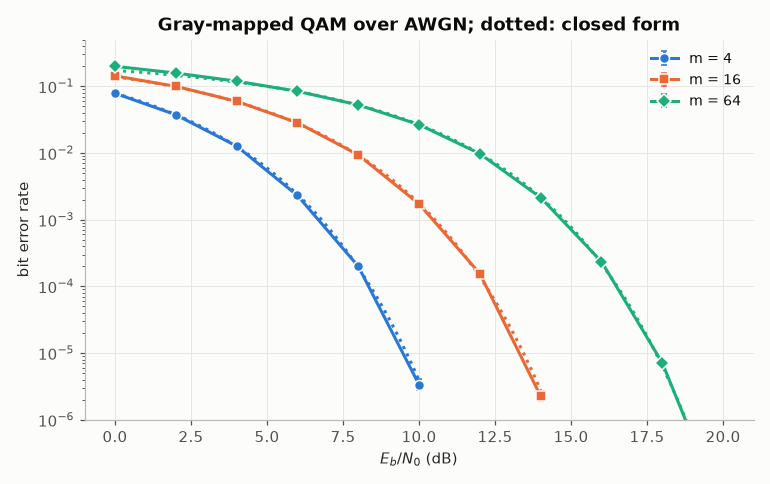
{'completed', 'skipped'} 33 conditions
Expected results. An expect entry names a source and what the campaign must
reproduce: a closed form (theory), a published curve (curve) or a value. The
check passes when the expectation lies in the confidence interval of the metric (here
the 99.9 % interval, plus a relative tolerance). comnum.verify_spec() runs the
campaign and reports every check; the specifications of specs/validation/ do
this in CI for the error rates of Proakis & Salehi, the information rates and figures
of the literature.
spec["expect"] = [
    {
        "name": "SER of square QAM (exact)",
        "source": "Proakis & Salehi, Digital Communications, 5th ed., Sec. 4.3-2",
        "metric": "ser",
        "theory": {"function": "ser", "kind": "qam", "m": "$m", "ebn0_db": "$ebn0_db"},
        "interval": 0.999,
        "rtol": 0.02,
    }
]
report = comnum.verify_spec(spec)
print("all checks passed:", report["passed"])
for c in report["checks"][:6]:
    print(f"  {c['condition']}: {c['metric']} = {c['value']:.3e}, expected {c['expected']:.3e}")
all checks passed: True
  m=4, ebn0_db=0: ser = 1.512e-01, expected 1.511e-01
  m=4, ebn0_db=2: ser = 7.330e-02, expected 7.361e-02
  m=4, ebn0_db=4: ser = 2.522e-02, expected 2.485e-02
  m=4, ebn0_db=6: ser = 4.593e-03, expected 4.771e-03
  m=4, ebn0_db=8: ser = 4.005e-04, expected 3.818e-04
  m=4, ebn0_db=10: ser = 6.714e-06, expected 7.744e-06
Operating points. A search section replaces the sweep of a variable by the
search of the value at which a metric reaches a target, for every combination of
the other axes: here the \(E_b/N_0\) required for a BER of \(10^{-3}\). The
bracket is halved on the same random streams (common random numbers) until it is
narrower than the tolerance. The result is compared with the inverted closed form.
search = dict(spec)
search.pop("expect")
search.pop("callbacks")
search["grid"] = {"m": [4, 16, 64]}
search["search"] = {"along": "ebn0_db", "range": [0, 20], "metric": "ber", "target": 1e-3,
                    "tolerance": 0.05}  # fmt: skip
for r in comnum.search_spec(search):
    m = r["condition"]["m"]
    lo, hi = 0.0, 20.0
    for _ in range(50):  # the closed form, inverted by bisection
        mid = (lo + hi) / 2
        lo, hi = (mid, hi) if comnum.theory_ber(m, mid, "qam") > 1e-3 else (lo, mid)
    print(
        f"{m:>2}-QAM: BER 1e-3 at Eb/N0 = {r['value']:.2f} dB "
        f"[{r['lo']:.2f}, {r['hi']:.2f}], closed form {lo:.2f} dB, {len(r['evaluations'])} evaluations"
    )
 4-QAM: BER 1e-3 at Eb/N0 = 6.86 dB [6.76, 6.97], closed form 6.79 dB, 11 evaluations
16-QAM: BER 1e-3 at Eb/N0 = 10.53 dB [10.46, 10.61], closed form 10.52 dB, 11 evaluations
64-QAM: BER 1e-3 at Eb/N0 = 14.79 dB [14.72, 14.86], closed form 14.77 dB, 11 evaluations
The command line. The binary comnum (cargo install comnum-spec, or
cargo build --release) runs the same files without Python, writes the JSON
and CSV reports to results/, and documents the blocks:
comnum check qam_awgn.yaml            # the link, the grid and the ports
comnum conditions qam_awgn.yaml       # the conditions of the grid
comnum run qam_awgn.yaml --out results --threads 8
comnum verify qam_awgn.yaml           # the expected results; exit code 1 on a failure
comnum blocks awgn_ebn0 source        # the parameters of a block, with units and defaults
comnum schema                         # the JSON Schema of the blocks, for editors
comnum run --fast-dev-run runs one trial per condition to check a file before a
long campaign. The reports are read back with comnum.Results.load().
Reading a file back. Chain.from_spec turns a file into a chain again, with
its grid, metrics and stopping rule as settings: a published campaign is rerun
with one block changed in a line.
again = comnum.Chain.from_spec(path)
print(again.names, again.settings["grid"])
harder = again.replace(channel=B.AwgnEbn0(ebn0_db=comnum.var("ebn0_db")))
print(np.array([r["status"] for r in harder.run(grid={"m": [16], "ebn0_db": [8, 10]})]))
['tx', 'channel'] {'m': [4, 16, 64], 'ebn0_db': {'from': 0, 'to': 20, 'step': 2}}
['completed' 'completed']
Total running time of the script: (0 minutes 7.282 seconds)