Ctrl+K

comnum

  • Getting started
  • Tutorials
  • User guide
  • Gallery of classical results
  • Why the results can be trusted
  • Maturity
    • Comparisons with other libraries
    • Why comnum
    • Benchmarks against other libraries
    • Classical performance
    • API reference
  • GitHub
  • Getting started
  • Tutorials
  • User guide
  • Gallery of classical results
  • Why the results can be trusted
  • Maturity
  • Comparisons with other libraries
  • Why comnum
  • Benchmarks against other libraries
  • Classical performance
  • API reference
  • GitHub

Section Navigation

  • Foundations
    • Constellations and Gray labels
    • Bit error rate of M-QAM over AWGN
    • M-PSK over AWGN with the Python runner
    • BPSK over flat Rayleigh fading
    • Information rates of QAM
  • Coding and shaping
    • Channel coding: from convolutional codes to the finite-length limit
    • Hu, Eleftheriou & Arnold 2005, Fig. 5: a regular PEG code of length 504
    • 5G NR channel codes: LDPC and polar
    • Probabilistic shaping: the rate gain and probabilistic amplitude shaping
  • Waveforms
    • PAPR of OFDM: the CCDF and its closed forms
    • PAPR reduction techniques
    • OFDM with impairments: imperfect channel estimates and nonlinear amplifiers
    • Proakis & Salehi 2008, Sec. 3.3-2: MSK has the error rate of BPSK
    • Thompson et al. 2008, Fig. 2: the CE-OFDM phase demodulator
    • CE-OFDM receivers, spectrum and bandwidth
    • The LoRa modulation: error rates, spectrum and interference
    • Filtered multicarrier and OTFS
  • MIMO
    • MIMO detection: linear, successive cancellation and maximum likelihood
    • Transmit diversity: Alamouti and space-time block codes
    • Alamouti 1998, Fig. 4: transmit diversity against MRRC
    • Ergodic capacity of MIMO channels
    • Large MIMO: message passing (LAMA and OAMP)
    • Biguesh & Gershman 2006, Fig. 4: LS, scaled LS, relaxed MMSE and LMMSE
  • Optical
    • Chromatic dispersion and its compensation
    • Nonlinear fibre propagation and digital back-propagation
    • Häger & Pfister 2021, Fig. 5: linear equalisation and back-propagation
    • WDM nonlinearity: the GN model and digital back-propagation
    • Raman amplification: pumps, gain flattening and the hybrid link
    • Mach–Zehnder and IQ modulators
    • Optical wireless: an LED-lit room and a turbulent free-space link
  • Hardware impairments
    • Power amplifiers and digital predistortion
    • DAC and ADC: quantisation, clipping and jitter
  • Receiver DSP
    • Nyquist pulse shaping and the eye diagram
    • OFDM over multipath: channel estimation
    • OFDM synchronisation and MIMO-OFDM
    • Blind receiver: modulation recognition, SNR and symbol rate
  • Metrics and analysis
    • Analysing a link: variants, probes and signals
  • Systems and standards
    • DVB-S2: MODCODs, constellations and frame error rates
    • 5G NR: numerology, synchronisation block and reference signals
    • DVB-S: the error rate after the Viterbi decoder against Table 3
    • DVB-T: the frame and the error rate after the Viterbi decoder against Annex A
    • CCSDS: the codes of telemetry against the normal approximation
    • 5G NR PDSCH: TS 38.101-4 test 1-2 against the RAN4 alignment
  • Simulation and specifications
    • A coherent receiver as a chain of blocks
    • Wireless links as chains: diversity, OFDM channel estimation, coded modulation
    • Recorded signals: SigMF in, blind receiver out
    • Coverage of the confidence intervals of an error rate
  • Gallery of classical results

Gallery of classical results#

The textbook curves of digital and optical communications, simulated with comnum and compared with their closed forms. Every script runs as is (the figures of this page are produced when the documentation is built), and the same results are checked at a few points by tests/test_performance.py.

Against the literature#

The scripts are grouped by theme, in the order of a link. Some reproduce one named figure or table of a paper or a standard, with the same system parameters, and say what the library’s curve is expected to match: where the published points are available as numbers, they are drawn on the figure; otherwise the caption names the figure to open next to the plot. The others compare with closed forms and cite the equations they use. The table below gathers every comparison of this gallery.

Reference

What is reproduced

Where

    1. Alamouti, IEEE J. Sel. Areas Commun. 16(8), 1998, Fig. 4

BER of coherent BPSK over Rayleigh fading: no diversity, MRRC with 2 and 4 receive antennas, the two-branch transmit diversity scheme with 1 and 2 receive antennas

Alamouti 1998, Fig. 4: transmit diversity against MRRC

X.-Y. Hu, E. Eleftheriou, D. M. Arnold, IEEE Trans. Inf. Theory 51(1), 2005, Fig. 5

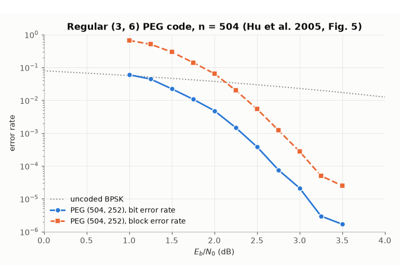
Bit and block error rates of a regular (3, 6) PEG code of length 504 over AWGN with BPSK and sum-product decoding

Hu, Eleftheriou & Arnold 2005, Fig. 5: a regular PEG code of length 504

    1. Thompson et al., IEEE Trans. Commun. 56(8), 2008, Fig. 2 and eq. (15)

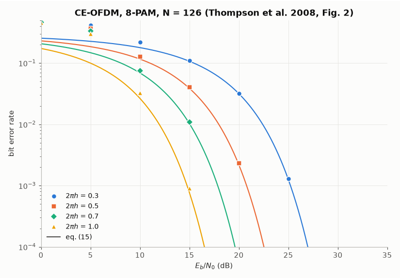
BER of the CE-OFDM phase demodulator receiver for 8-PAM data and several modulation indices, against the high-CNR approximation

Thompson et al. 2008, Fig. 2: the CE-OFDM phase demodulator

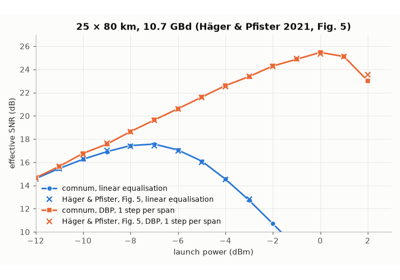
  1. Häger, H. D. Pfister, IEEE J. Sel. Areas Commun. 39(1), 2021, Fig. 5

Effective SNR versus launch power over 25 × 80 km, linear equalisation and digital back-propagation with one step per span; the published points are drawn

Häger & Pfister 2021, Fig. 5: linear equalisation and back-propagation

    1. Proakis, M. Salehi, Digital Communications, 5th ed., 2008, Sec. 3.3-2

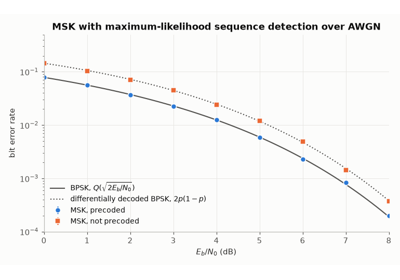
MSK detected by maximum-likelihood sequence detection has the BER of BPSK once precoded; without precoding, that of differentially decoded BPSK

Proakis & Salehi 2008, Sec. 3.3-2: MSK has the error rate of BPSK

J. Guerreiro et al., IEEE Commun. Lett. 20(11), 2016, Fig. 1 and eq. (8); M. J. López Morales et al., Globecom Workshops 2022, Fig. 3; A. U. Ahmed, J. R. Zeidler, IEEE Trans. Signal Process. 63(17), 2015, Fig. 6; R. A. Pacheco, D. Hatzinakos, ICASSP 2006, Fig. 1; J. Guerreiro et al., VTC Fall 2015, Fig. 3

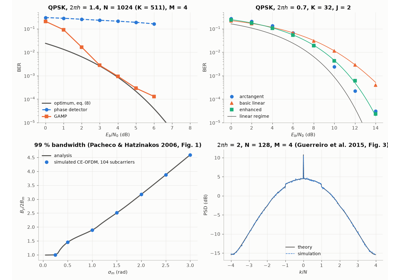
CE-OFDM: the phase detector, GAMP and the optimum BER at \(2\pi h = 1.4\); the arctangent, basic linear and enhanced receivers at 0.7; the 99 % bandwidth; the spectrum at \(2\pi h = 2\)

CE-OFDM receivers, spectrum and bandwidth

O. Afisiadis et al., IEEE Trans. Wireless Commun. 19(2), 2020, Figs. 2 and 7; L. Vangelista, IEEE Signal Process. Lett. 24(12), 2017, Fig. 1; M. Chiani, A. Elzanaty, IEEE Internet Things J. 6(5), 2019, Fig. 3a

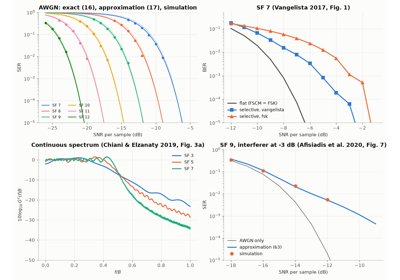
The LoRa modulation: the SER over AWGN for SF 7 to 12, FSCM against FSK over a frequency-selective channel, the continuous spectrum, a same-SF interferer

The LoRa modulation: error rates, spectrum and interference

ETSI EN 302 307-1 V1.4.1, Table 13

The \(E_s/N_0\) thresholds of the 28 DVB-S2 MODCODs against the simulated frame error rates

DVB-S2: MODCODs, constellations and frame error rates

Proakis & Salehi, 5th ed., Secs. 4.3 and 13.3; eq. (13.4-15)

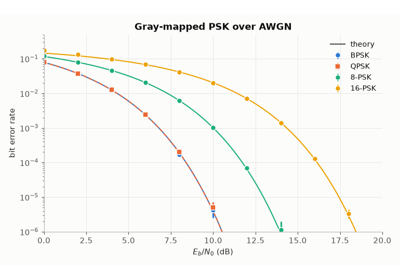
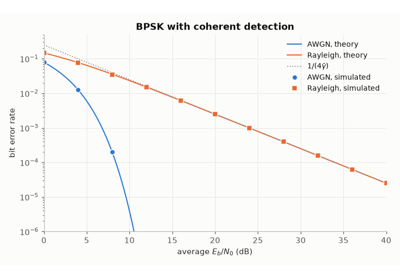
Error rates of QAM, PSK and PAM over AWGN, BPSK over Rayleigh fading, maximal-ratio combining

Bit error rate of M-QAM over AWGN, M-PSK over AWGN with the Python runner, BPSK over flat Rayleigh fading, Transmit diversity: Alamouti and space-time block codes

  1. Ochiai, H. Imai, IEEE Trans. Commun. 49(2), 2001, eqs. (11) and (27)

The distribution of the PAPR of OFDM at the Nyquist rate and oversampled

PAPR of OFDM: the CCDF and its closed forms

  1. Polyanskiy, H. V. Poor, S. Verdú, IEEE Trans. Inf. Theory 56(5), 2010

The normal approximation of the finite-length limit, against polar and LDPC codes of length 256

Channel coding: from convolutional codes to the finite-length limit

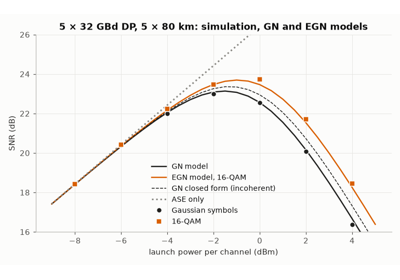
P. Poggiolini, J. Lightw. Technol. 30(24), 2012; A. Carena et al., Opt. Express 22(13), 2014

The GN and EGN models of nonlinear interference against split-step simulations of a WDM link

WDM nonlinearity: the GN model and digital back-propagation

  1. Böcherer, F. Steiner, P. Schulte, IEEE Trans. Commun. 63(12), 2015

Probabilistic amplitude shaping of 64-QAM at 3 bits per symbol

Probabilistic shaping: the rate gain and probabilistic amplitude shaping

The README of references/ in the repository lists every document the library is validated against, with its status, and specs/validation/ holds the campaigns that CI checks against these sources.

Foundations#

Constellations, error rates over AWGN and Rayleigh fading against their closed forms, information rates.
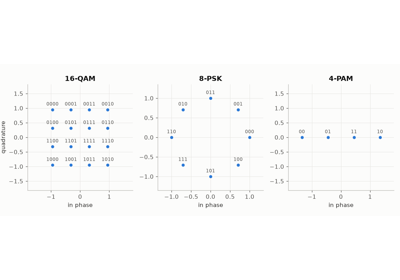
Constellations and Gray labels

Constellations and Gray labels

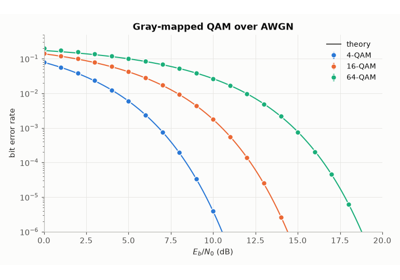
Bit error rate of M-QAM over AWGN

Bit error rate of M-QAM over AWGN

M-PSK over AWGN with the Python runner

M-PSK over AWGN with the Python runner

BPSK over flat Rayleigh fading

BPSK over flat Rayleigh fading

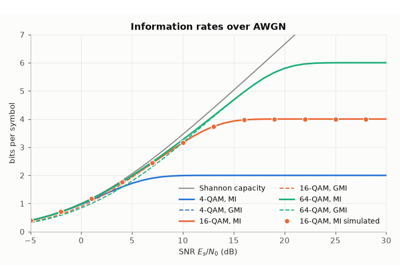
Information rates of QAM

Information rates of QAM

Coding and shaping#

Channel codes against the finite-length limits and the literature, the codes of 5G NR, probabilistic amplitude shaping.
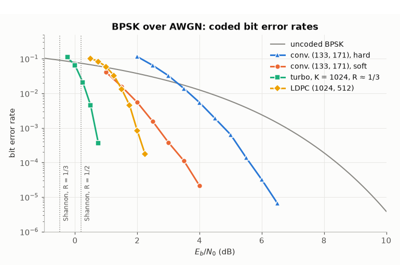
Channel coding: from convolutional codes to the finite-length limit
Channel coding: from convolutional codes to the finite-length limit

Hu, Eleftheriou & Arnold 2005, Fig. 5: a regular PEG code of length 504
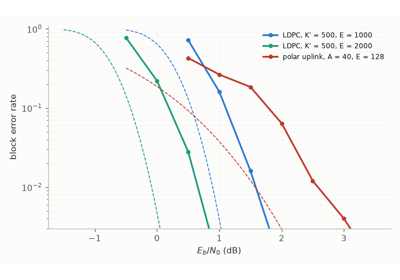
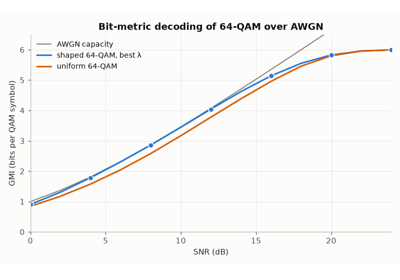
Hu, Eleftheriou & Arnold 2005, Fig. 5: a regular PEG code of length 504

5G NR channel codes: LDPC and polar

5G NR channel codes: LDPC and polar

Probabilistic shaping: the rate gain and probabilistic amplitude shaping

Probabilistic shaping: the rate gain and probabilistic amplitude shaping

Waveforms#

OFDM and its PAPR, continuous-phase modulation, constant-envelope OFDM, chirp spread spectrum, filtered multicarrier (FBMC/OQAM, UFMC) and OTFS.
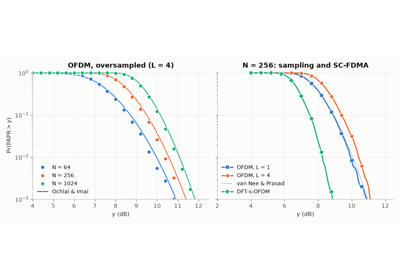
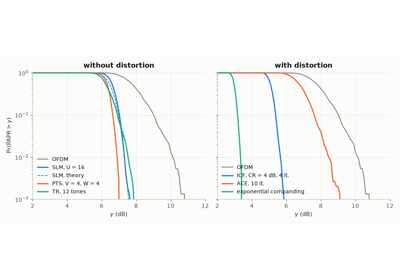
PAPR of OFDM: the CCDF and its closed forms

PAPR of OFDM: the CCDF and its closed forms

PAPR reduction techniques

PAPR reduction techniques

OFDM with impairments: imperfect channel estimates and nonlinear amplifiers
OFDM with impairments: imperfect channel estimates and nonlinear amplifiers

Proakis & Salehi 2008, Sec. 3.3-2: MSK has the error rate of BPSK
Proakis & Salehi 2008, Sec. 3.3-2: MSK has the error rate of BPSK

Thompson et al. 2008, Fig. 2: the CE-OFDM phase demodulator
Thompson et al. 2008, Fig. 2: the CE-OFDM phase demodulator

CE-OFDM receivers, spectrum and bandwidth

CE-OFDM receivers, spectrum and bandwidth

The LoRa modulation: error rates, spectrum and interference
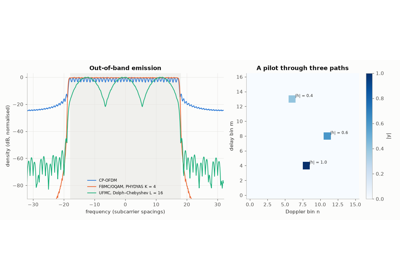
The LoRa modulation: error rates, spectrum and interference

Filtered multicarrier and OTFS

Filtered multicarrier and OTFS

MIMO#

Detection, space-time codes, capacity, message passing for large MIMO.
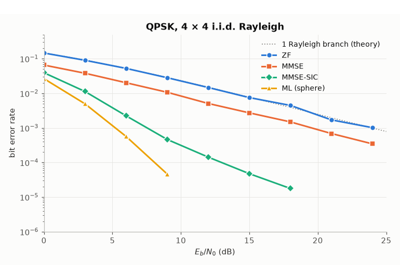
MIMO detection: linear, successive cancellation and maximum likelihood
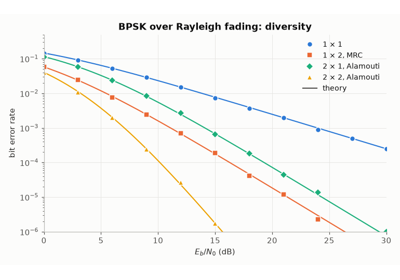
MIMO detection: linear, successive cancellation and maximum likelihood

Transmit diversity: Alamouti and space-time block codes
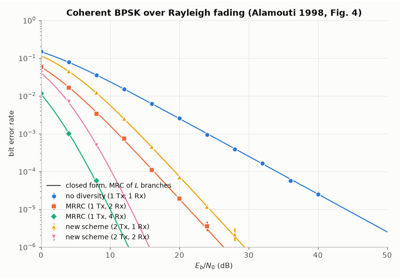
Transmit diversity: Alamouti and space-time block codes

Alamouti 1998, Fig. 4: transmit diversity against MRRC
Alamouti 1998, Fig. 4: transmit diversity against MRRC
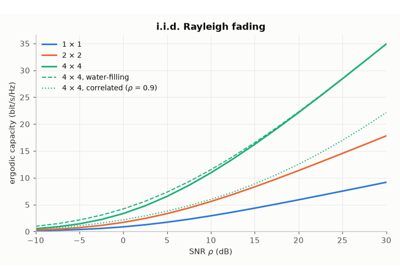
Ergodic capacity of MIMO channels

Ergodic capacity of MIMO channels

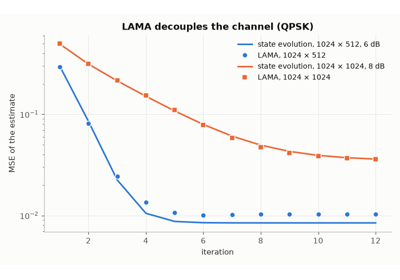
Large MIMO: message passing (LAMA and OAMP)

Large MIMO: message passing (LAMA and OAMP)

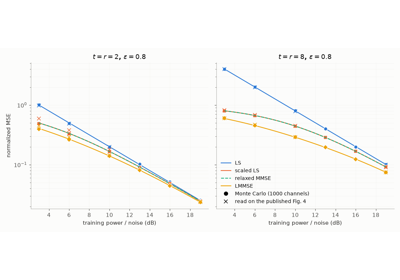
Biguesh & Gershman 2006, Fig. 4: LS, scaled LS, relaxed MMSE and LMMSE

Biguesh & Gershman 2006, Fig. 4: LS, scaled LS, relaxed MMSE and LMMSE

Optical#

Fibre propagation and its compensation, nonlinear interference, Raman amplification, optical modulators; optical wireless links (visible light indoors, free-space optics).
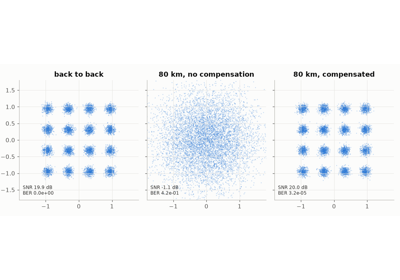
Chromatic dispersion and its compensation

Chromatic dispersion and its compensation

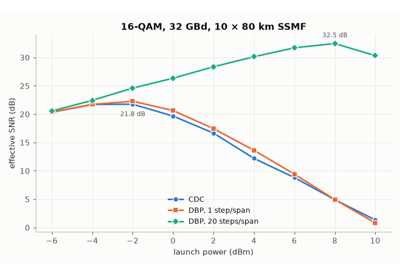
Nonlinear fibre propagation and digital back-propagation
Nonlinear fibre propagation and digital back-propagation

Häger & Pfister 2021, Fig. 5: linear equalisation and back-propagation
Häger & Pfister 2021, Fig. 5: linear equalisation and back-propagation

WDM nonlinearity: the GN model and digital back-propagation
WDM nonlinearity: the GN model and digital back-propagation

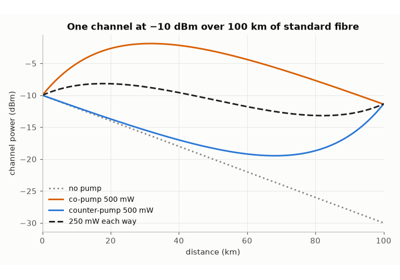
Raman amplification: pumps, gain flattening and the hybrid link
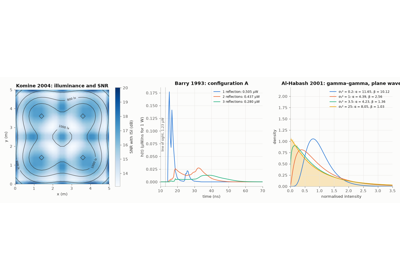
Raman amplification: pumps, gain flattening and the hybrid link

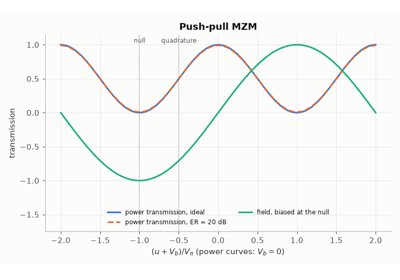
Mach–Zehnder and IQ modulators

Mach–Zehnder and IQ modulators

Optical wireless: an LED-lit room and a turbulent free-space link

Optical wireless: an LED-lit room and a turbulent free-space link

Hardware impairments#

Power amplifiers and their predistortion, converters.
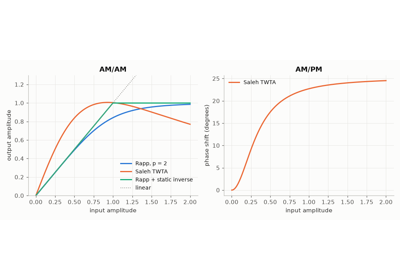
Power amplifiers and digital predistortion

Power amplifiers and digital predistortion

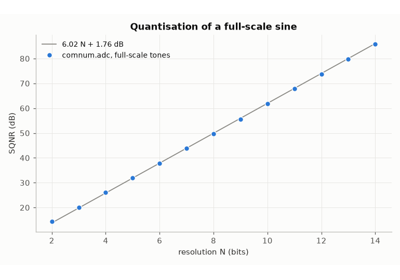
DAC and ADC: quantisation, clipping and jitter

DAC and ADC: quantisation, clipping and jitter

Receiver DSP#

Pulse shaping, channel estimation, synchronisation, blind modulation recognition.
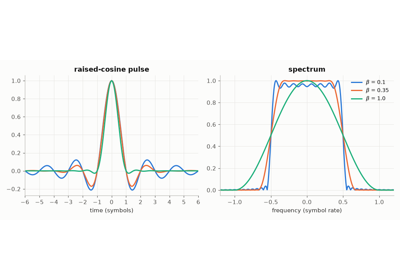
Nyquist pulse shaping and the eye diagram

Nyquist pulse shaping and the eye diagram

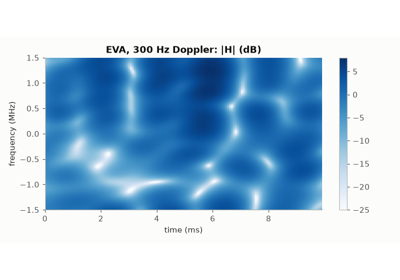
OFDM over multipath: channel estimation

OFDM over multipath: channel estimation

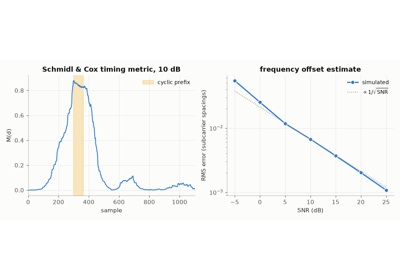
OFDM synchronisation and MIMO-OFDM

OFDM synchronisation and MIMO-OFDM

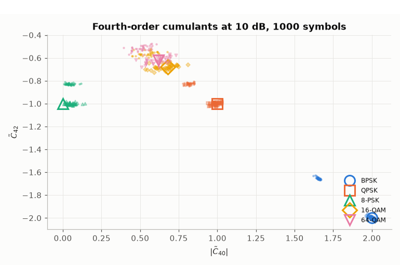
Blind receiver: modulation recognition, SNR and symbol rate

Blind receiver: modulation recognition, SNR and symbol rate

Metrics and analysis#

The views of a signal and of the results of a campaign.
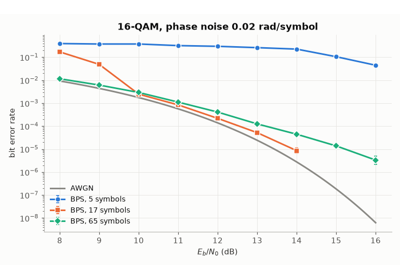
Analysing a link: variants, probes and signals

Analysing a link: variants, probes and signals

Systems and standards#

DVB-S, DVB-S2, DVB-T, CCSDS and 5G NR.
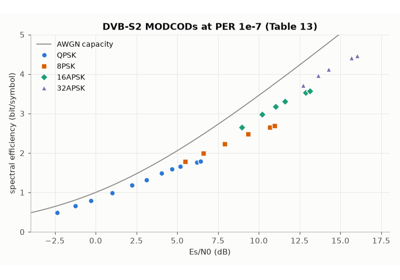
DVB-S2: MODCODs, constellations and frame error rates
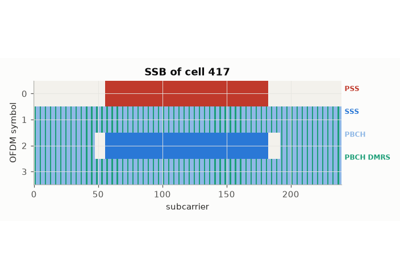
DVB-S2: MODCODs, constellations and frame error rates

5G NR: numerology, synchronisation block and reference signals
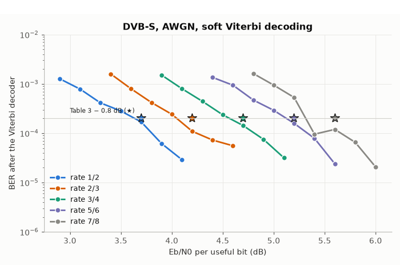
5G NR: numerology, synchronisation block and reference signals

DVB-S: the error rate after the Viterbi decoder against Table 3
DVB-S: the error rate after the Viterbi decoder against Table 3

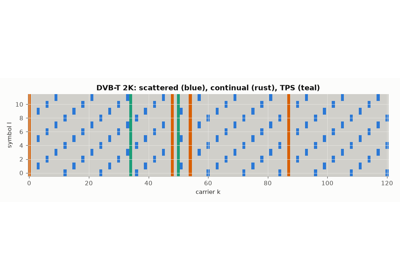
DVB-T: the frame and the error rate after the Viterbi decoder against Annex A
DVB-T: the frame and the error rate after the Viterbi decoder against Annex A

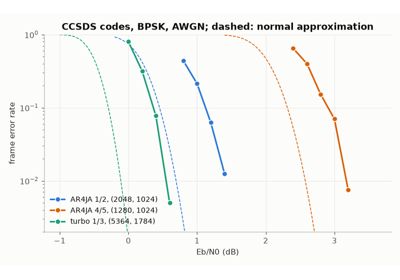
CCSDS: the codes of telemetry against the normal approximation
CCSDS: the codes of telemetry against the normal approximation

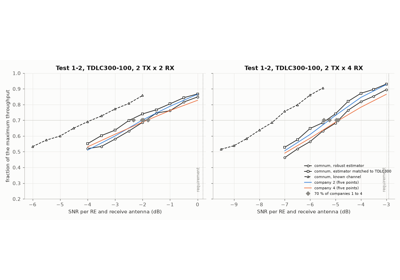
5G NR PDSCH: TS 38.101-4 test 1-2 against the RAN4 alignment

5G NR PDSCH: TS 38.101-4 test 1-2 against the RAN4 alignment

Simulation and specifications#

Chains of blocks and their campaigns, recordings of measured signals, the confidence intervals of an error rate.
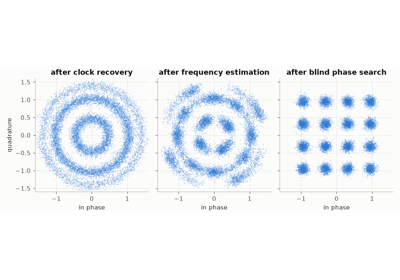
A coherent receiver as a chain of blocks

A coherent receiver as a chain of blocks

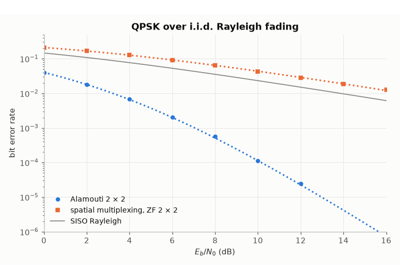
Wireless links as chains: diversity, OFDM channel estimation, coded modulation
Wireless links as chains: diversity, OFDM channel estimation, coded modulation
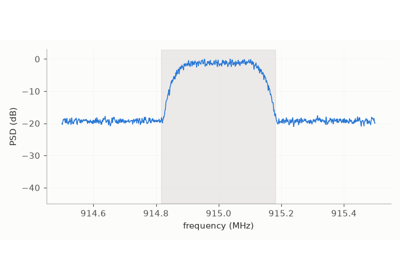
Recorded signals: SigMF in, blind receiver out

Recorded signals: SigMF in, blind receiver out

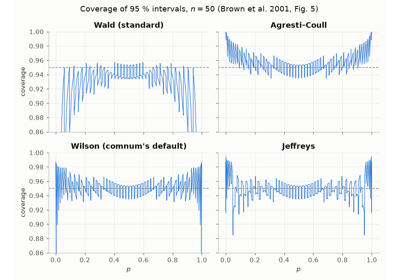
Coverage of the confidence intervals of an error rate

Coverage of the confidence intervals of an error rate

Gallery generated by Sphinx-Gallery

previous

Recordings

next

Foundations

On this page
  • Against the literature
  • Foundations
  • Coding and shaping
  • Waveforms
  • MIMO
  • Optical
  • Hardware impairments
  • Receiver DSP
  • Metrics and analysis
  • Systems and standards
  • Simulation and specifications
Show Source

© Copyright 2022-2026, Vincent Choqueuse.

Created using Sphinx 9.1.1.

Built with the PyData Sphinx Theme 0.24.0.