Ctrl+K

comnum

  • Getting started
  • Tutorials
  • User guide
  • Gallery of classical results
  • Why the results can be trusted
  • Maturity
    • Comparisons with other libraries
    • Why comnum
    • Benchmarks against other libraries
    • Classical performance
    • API reference
  • GitHub
  • Getting started
  • Tutorials
  • User guide
  • Gallery of classical results
  • Why the results can be trusted
  • Maturity
  • Comparisons with other libraries
  • Why comnum
  • Benchmarks against other libraries
  • Classical performance
  • API reference
  • GitHub

Section Navigation

  • Foundations
    • Constellations and Gray labels
    • Bit error rate of M-QAM over AWGN
    • M-PSK over AWGN with the Python runner
    • BPSK over flat Rayleigh fading
    • Information rates of QAM
  • Coding and shaping
    • Channel coding: from convolutional codes to the finite-length limit
    • Hu, Eleftheriou & Arnold 2005, Fig. 5: a regular PEG code of length 504
    • 5G NR channel codes: LDPC and polar
    • Probabilistic shaping: the rate gain and probabilistic amplitude shaping
  • Waveforms
    • PAPR of OFDM: the CCDF and its closed forms
    • PAPR reduction techniques
    • OFDM with impairments: imperfect channel estimates and nonlinear amplifiers
    • Proakis & Salehi 2008, Sec. 3.3-2: MSK has the error rate of BPSK
    • Thompson et al. 2008, Fig. 2: the CE-OFDM phase demodulator
    • CE-OFDM receivers, spectrum and bandwidth
    • The LoRa modulation: error rates, spectrum and interference
    • Filtered multicarrier and OTFS
  • MIMO
    • MIMO detection: linear, successive cancellation and maximum likelihood
    • Transmit diversity: Alamouti and space-time block codes
    • Alamouti 1998, Fig. 4: transmit diversity against MRRC
    • Ergodic capacity of MIMO channels
    • Large MIMO: message passing (LAMA and OAMP)
    • Biguesh & Gershman 2006, Fig. 4: LS, scaled LS, relaxed MMSE and LMMSE
  • Optical
    • Chromatic dispersion and its compensation
    • Nonlinear fibre propagation and digital back-propagation
    • Häger & Pfister 2021, Fig. 5: linear equalisation and back-propagation
    • WDM nonlinearity: the GN model and digital back-propagation
    • Raman amplification: pumps, gain flattening and the hybrid link
    • Mach–Zehnder and IQ modulators
    • Optical wireless: an LED-lit room and a turbulent free-space link
  • Hardware impairments
    • Power amplifiers and digital predistortion
    • DAC and ADC: quantisation, clipping and jitter
  • Receiver DSP
    • Nyquist pulse shaping and the eye diagram
    • OFDM over multipath: channel estimation
    • OFDM synchronisation and MIMO-OFDM
    • Blind receiver: modulation recognition, SNR and symbol rate
  • Metrics and analysis
    • Analysing a link: variants, probes and signals
  • Systems and standards
    • DVB-S2: MODCODs, constellations and frame error rates
    • 5G NR: numerology, synchronisation block and reference signals
    • DVB-S: the error rate after the Viterbi decoder against Table 3
    • DVB-T: the frame and the error rate after the Viterbi decoder against Annex A
    • CCSDS: the codes of telemetry against the normal approximation
    • 5G NR PDSCH: TS 38.101-4 test 1-2 against the RAN4 alignment
  • Simulation and specifications
    • A coherent receiver as a chain of blocks
    • Wireless links as chains: diversity, OFDM channel estimation, coded modulation
    • Recorded signals: SigMF in, blind receiver out
    • Coverage of the confidence intervals of an error rate
  • Gallery of classical results
  • Receiver DSP

Receiver DSP#

Pulse shaping, channel estimation, synchronisation, blind modulation recognition.
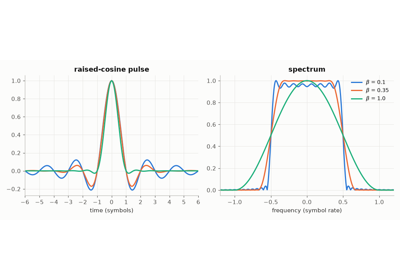
Nyquist pulse shaping and the eye diagram

Nyquist pulse shaping and the eye diagram

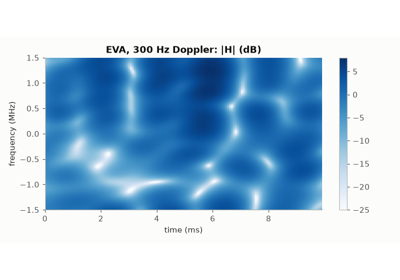
OFDM over multipath: channel estimation

OFDM over multipath: channel estimation

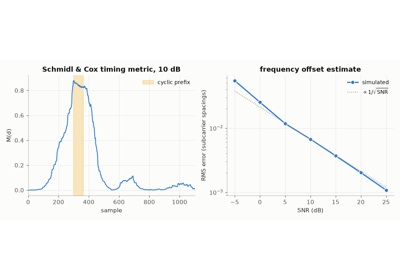
OFDM synchronisation and MIMO-OFDM

OFDM synchronisation and MIMO-OFDM

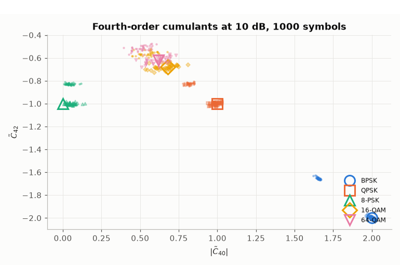
Blind receiver: modulation recognition, SNR and symbol rate

Blind receiver: modulation recognition, SNR and symbol rate

previous

DAC and ADC: quantisation, clipping and jitter

next

Nyquist pulse shaping and the eye diagram

Show Source

© Copyright 2022-2026, Vincent Choqueuse.

Created using Sphinx 9.1.1.

Built with the PyData Sphinx Theme 0.24.0.