
Note
Go to the end to download the full example code.
A coherent receiver as a chain of blocks#
The declarative link specs/coherent_link.yaml — 16-QAM at 32 GBd over standard
fibre, with laser phase noise, a detuned local oscillator, and the standard receiver
DSP (dispersion compensation, matched filter, Gardner clock recovery, fourth-power
frequency estimation, blind phase search, frame synchronisation) — read as a
comnum.Chain.
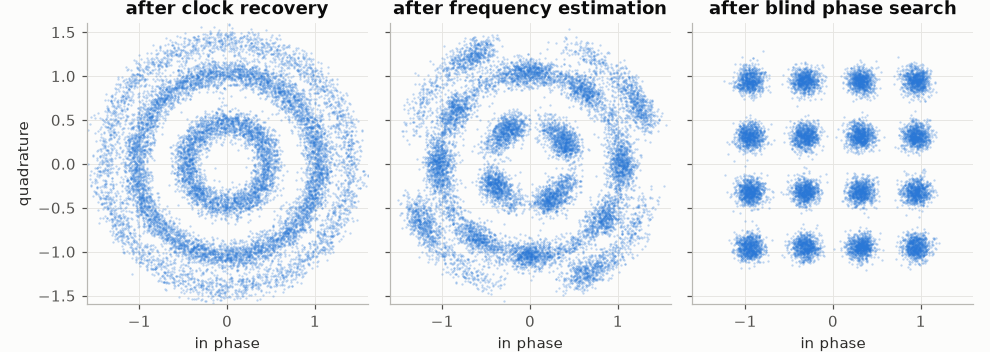
Trace. Chain.trace returns the frame after every block: the constellation
spins under the frequency offset, is stopped by the frequency estimator (Leven et al.
2007) and its residual phase noise removed by blind phase search (Pfau, Hoffmann &
Noé 2009).
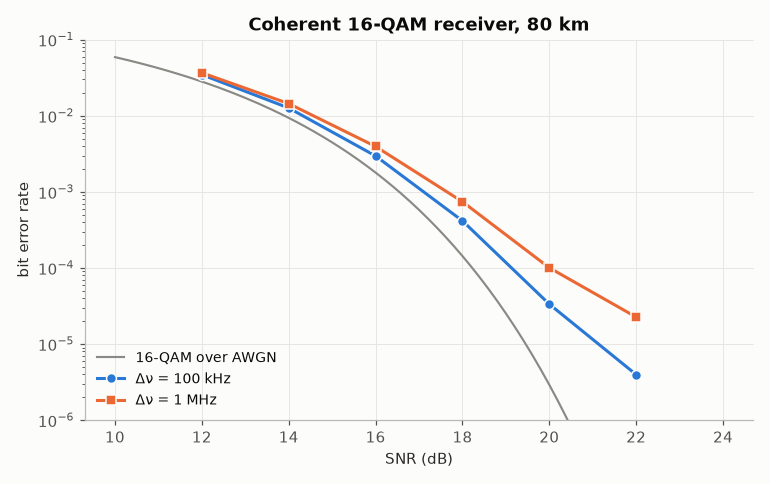
Variants. Chain.replace changes a block by name. Raising the linewidth of both
lasers from 100 kHz to 1 MHz leaves blind phase search with a larger linewidth-symbol
duration product, \(\Delta\nu T = 3 \cdot 10^{-5}\) per laser instead of
\(3 \cdot 10^{-6}\), and a larger penalty with respect to 16-QAM over AWGN at the
same SNR. Both campaigns run on the parallel Rust runner.
import matplotlib.pyplot as plt
import numpy as np
from _gallery_utils import SPECS

import comnum
from comnum import blocks as B
from comnum.plot import BACKGROUND, BLUE, GREY

spec = SPECS / "coherent_link.yaml"
link = comnum.Chain.from_spec(spec)
print(link)
Chain(
    source=Source(constellation='16-QAM', n_symbols=16384, symbol_rate=32000000000.0),
    pulse_shape=PulseShape(sps=2, rolloff=0.2),
    tx_laser=PhaseNoise(linewidth_hz=100000.0),
    fiber=Fiber(length_km=var('length_km')),
    normalize=Normalize(),
    awgn=Awgn(snr_db=var('snr_db')),
    lo_laser=PhaseNoise(linewidth_hz=100000.0),
    cfo=Cfo(offset_hz=-500000000.0),
    cdc=Cdc(length_km=var('length_km')),
    matched_filter=MatchedFilter(rolloff=0.2),
    gardner=Gardner(kp=0.003, ki=1e-05),
    decimate=Decimate(),
    foe=Foe(refined=True),
    bps=Bps(n=32, b=32),
    frame_sync=FrameSync(start=2048, length=512, max_delay=64)
)
The constellation after the main stages of the receiver.
frames = link.trace({"length_km": 80, "snr_db": 20}, comnum.Rng(3))
stages = {
    "decimate": "after clock recovery",
    "foe": "after frequency estimation",
    "bps": "after blind phase search",
}
fig, axes = plt.subplots(1, 3, figsize=(9, 3.2), sharex=True, sharey=True)
for ax, (name, title) in zip(axes, stages.items(), strict=True):
    y = frames[name].samples[2560:-256]
    ax.plot(y.real, y.imag, ".", markersize=1.0, alpha=0.3, color=BLUE)
    ax.set(title=title, aspect="equal", xlim=(-1.6, 1.6), ylim=(-1.6, 1.6))
    ax.set_xlabel("in phase")
axes[0].set_ylabel("quadrature")
fig.tight_layout()
Bit error rate against the SNR, for two laser linewidths.
snr = np.arange(12.0, 22.1, 2.0)
campaign = {
    "grid": {"length_km": [80], "snr_db": list(snr)},
    "stop": {"min_errors": {"ber": 200}, "min_trials": 8, "max_trials": 256},
}
variants = {
    "Δν = 100 kHz": link,
    "Δν = 1 MHz": link.replace(
        tx_laser=B.PhaseNoise(linewidth_hz=1e6), lo_laser=B.PhaseNoise(linewidth_hz=1e6)
    ),
}
fig, ax = plt.subplots()
s = np.linspace(10, 24, 141)
ax.semilogy(
    s,
    comnum.theory_ber(16, s - comnum.lin2db(4), "qam"),
    color=GREY,
    linewidth=1.4,
    label="16-QAM over AWGN",
)
for (name, chain), marker in zip(variants.items(), ["o", "s"], strict=True):
    res = chain.run(**campaign)
    _, ber = res.series("snr_db", "ber")
    keep = ber > 0
    ax.semilogy(snr[keep], ber[keep], marker=marker, markeredgecolor=BACKGROUND, label=name)
ax.set(
    xlabel="SNR (dB)",
    ylabel="bit error rate",
    ylim=(1e-6, 0.1),
    title="Coherent 16-QAM receiver, 80 km",
)
ax.legend(loc="lower left")
fig.tight_layout()
Total running time of the script: (0 minutes 4.834 seconds)